
Exemplifying our commitment to world-leading translational research, the Lions Eye Institute is using advanced retinal imaging to develop a novel, non-invasive test for detecting solid organ cancers.
The central concept is simple but potentially transformative. The eye provides a direct optical window into the body’s microcirculation and subtle cancer-related vascular changes may be detectable in the retina before they are clinically apparent elsewhere.
The work is led by Professor Chandra Balaratnasingam, Associate Professor Paula Yu and Dr Brendan Luu, in collaboration with Associate Professor Tarek Meniawy from Sir Charles Gairdner Hospital. It is also supported by Professor Mariapia Degli-Esposti and Dr Iona Schuster at Monash University, reflecting a cross-disciplinary approach to discovery.
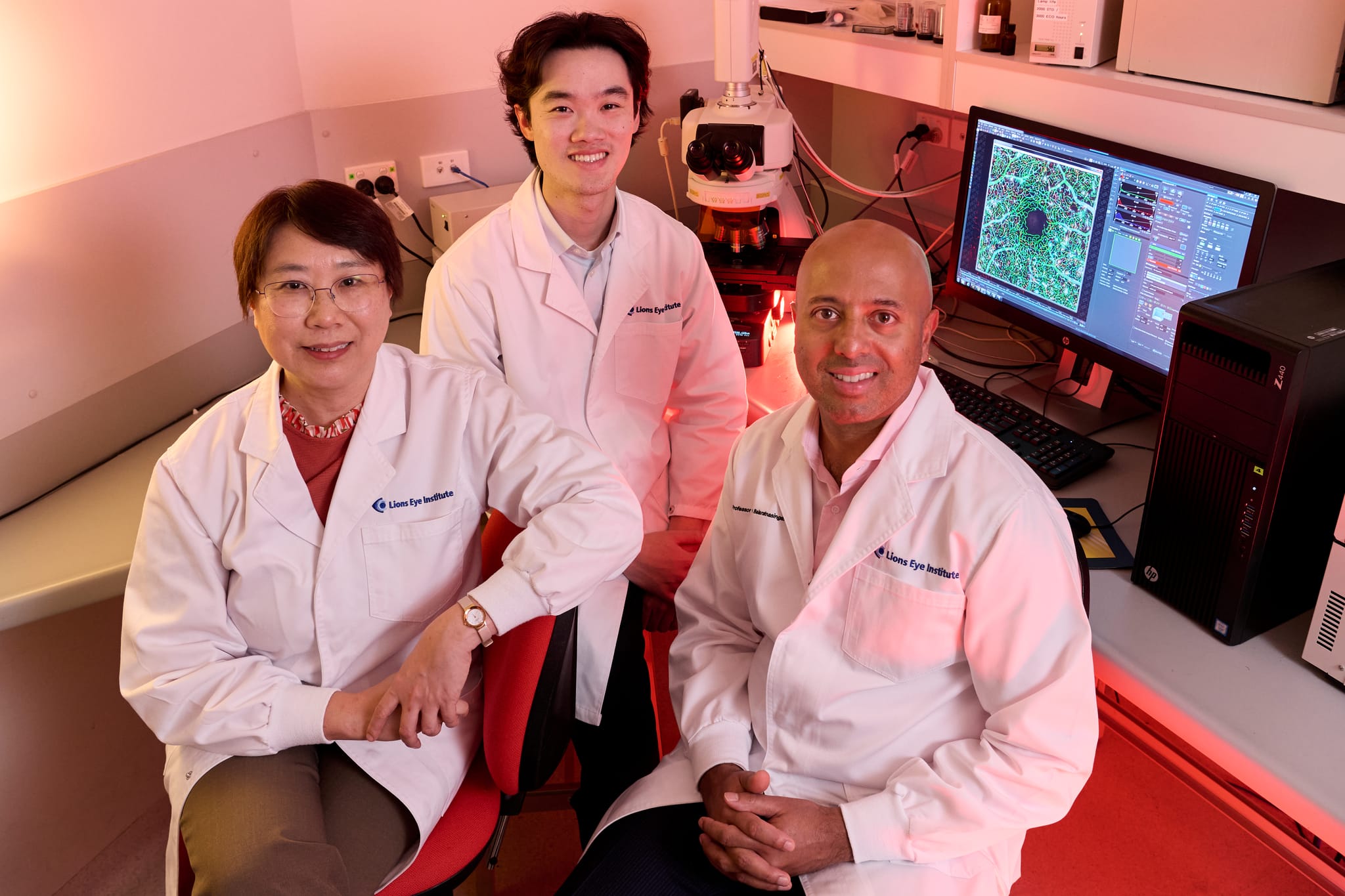
Associate Professor Paula Yu, Dr Brendan Luu and Professor Chandra Balaratnasingam are using advanced retinal imaging to develop a novel, non-invasive test for detecting solid organ cancers
The urgent need to find cancer earlier
Cancer remains one of the major causes of death in Australia and worldwide. Early detection is one of the most powerful ways to improve survival rates.
Current screening pathways, however, remain fragmented and organ-specific. In Australia, established population-based screening programmes are available for breast, cervical and bowel cancer, with a risk-based lung cancer programme being introduced. Many other cancers, including ovarian and pancreatic cancer, still lack effective screening tests and diagnostic pathways may be invasive, expensive or inaccessible.
Rather than developing a separate test for each cancer type, the Lions Eye Institute’s research team is investigating whether a single retinal scan can detect a shared biological signature of cancer: angiogenesis, the growth of new blood vessels driven by tumour-related growth factors.
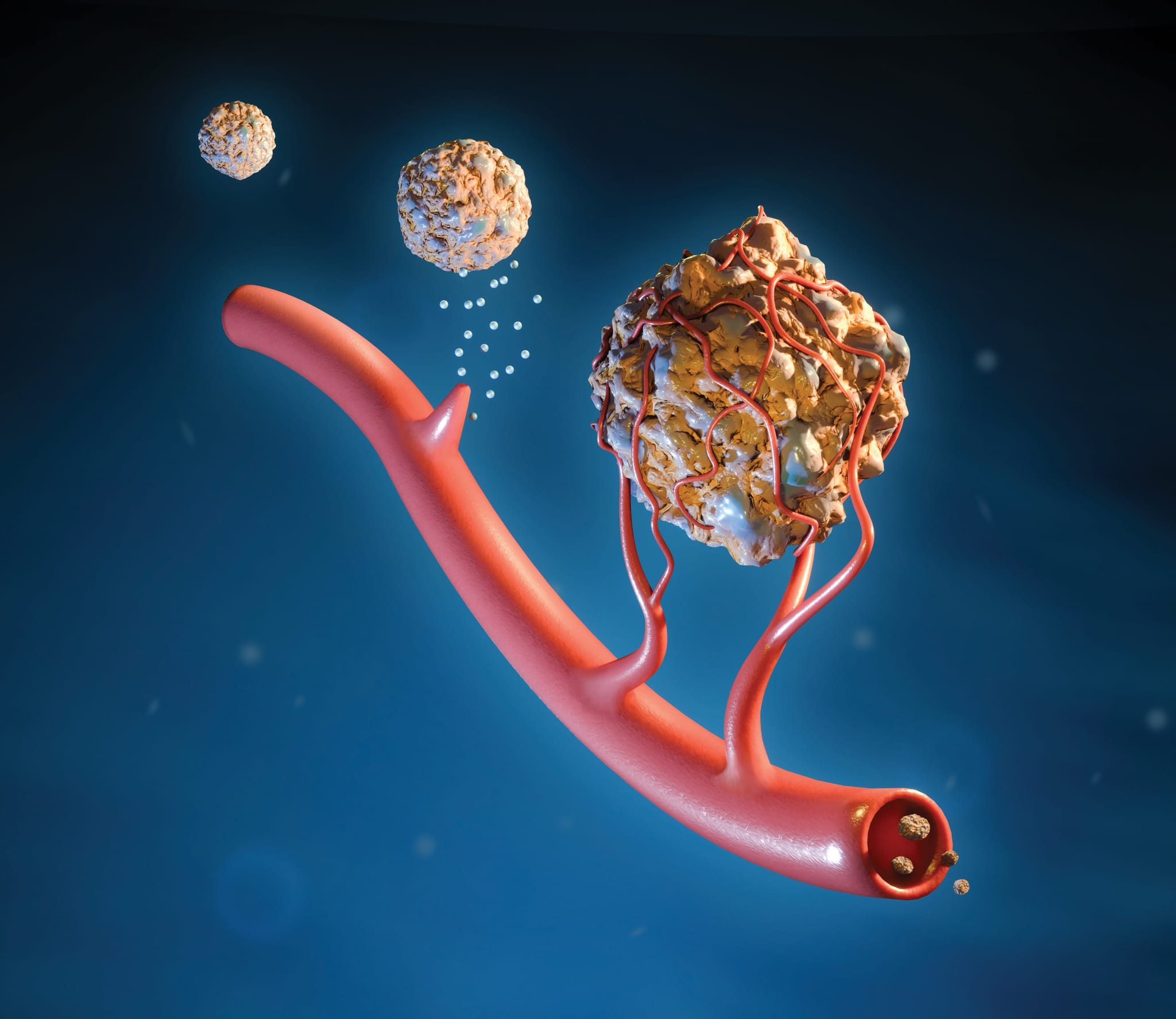 Image illustrating tumour angiogenesis, including growth factors (blue dots) that stimulate angiogenesis. |
What is Angiogenesis?Angiogenesis is the process your body uses to grow new blood vessels. It’s a normal and important part of healing and growth. But in cancer, tumours can use angiogenesis to feed themselves and grow. That’s why some treatments focus on stopping this process – to help slow or stop the cancer. |
How the eye could reveal cancer elsewhere in the body
Many solid organ cancers release elevated levels of growth factors into the blood and surrounding tissues. These molecules are central to tumour angiogenesis, allowing cancers to attract new blood vessels, grow and spread. The retina is especially sensitive to changes in growth factor signalling because it has a dense microcirculation and high expression of growth factor receptors, making it a unique biological sensor of systemic vascular change.
Associate Professor Paula Yu has generated preliminary evidence from human donor eyes showing that solid organ cancers may induce a distinct pattern of retinal angiogenesis. These changes appear to differ from patterns seen in retinal vascular diseases such as diabetic retinopathy. The team’s working hypothesis is that cancer-induced retinal angiogenesis can be characterised, quantified and ultimately used as a biomarker of systemic cancer activity.
The programme has two complementary arms. First, the laboratory team is using human donor eyes obtained through the Lions Eye Bank to define the structural and cellular features of cancer-induced retinal vascular change. This includes high-resolution immunolabelling and confocal microscopy to examine the retinal microcirculation in exceptional detail. In partnership with Monash University, the team is also studying cancer-related vascular effects in mouse models, strengthening the biological foundation of the work.
Second, the clinical team is validating these findings in living patients using optical coherence tomography angiography (OCTA). OCTA is a rapid, dye-free and non-invasive imaging technology that can visualise the microscopic blood vessels of the retina in real time.
The Institute’s team has spent more than a decade refining OCTA methods that quantify both retinal microvascular structure and blood-flow behaviour. A key strength is that these OCTA methods have been validated against human retinal histology, providing a rigorous foundation for clinical interpretation.
Building a bridge between laboratory discovery and clinical impact
Through collaboration with Associate Professor Meniawy and the Department of Medical Oncology at Sir Charles Gairdner Hospital, the Lions Eye Institute has begun recruiting patients with newly diagnosed solid organ cancers into the clinical arm of the study. Imaging is performed before cancer treatment wherever possible, allowing the team to study cancer-related retinal vascular changes without the confounding effects of therapy.
The study will compare retinal imaging findings in cancer patients with those of healthy control participants and examine whether retinal vascular changes correlate with cancer type and stage.
If successful, this work could establish a new clinical biomarker for cancer-induced angiogenesis and provide a platform for earlier detection, risk stratification and monitoring of response to anti-angiogenic cancer therapies.
A future where one eye scan could help detect cancer
The long-term vision is to create a rapid, affordable and scalable cancer detection platform that could be integrated into existing ophthalmic and optometric workflows. Because OCT and OCTA technologies are already widely used in eye care, this approach has a practical pathway to broad implementation without the need for entirely new clinical infrastructure.
Beyond cancer screening, the programme may open new avenues for understanding how systemic disease is reflected in the eye. It also positions the Lions Eye Institute at the forefront of a new field linking retinal imaging, vascular biology and oncology.
Thank you for helping make this possible
We gratefully acknowledge the Perth Eye Foundation, the Charlies Foundation for Research and our supporters for their visionary investment in this work. Their support is enabling our researchers to pursue a bold idea with the potential to change how cancer is detected, monitored and understood – bringing hope to patients and families in Western Australia and beyond.

