
At the Lions Eye Institute, we remain at the forefront of research into vision restoration.
One of the clinical trials we are fortunate to be participating in, the Abacus-2 Study, is offering hope to individuals suffering from the most advanced stages of retinitis pigmentosa, a condition that leads to severe visual impairment and, in many cases, complete blindness.
About the Abacus-2 study
The Abacus-2 Study is a clinical trial sponsored by Kiora, a pharmaceutical company headquartered in California, USA, with operations in Vienna, Austria and Melbourne, Australia. This study aims to evaluate the effectiveness of KIO-301, an innovative photoswitch molecule, in individuals who are in the advanced stages of retinitis pigmentosa and have substantial vision impairment.
Retinitis pigmentosa is a genetic disorder that causes the gradual degeneration of photoreceptor cells in the retina, primarily rods and cones, which are responsible for vision. As these cells deteriorate, individuals lose their ability to see. KIO-301 is a gene mutation-agnostic treatment designed to convert retinal ganglion cells into light-perceiving cells. The goal is to stimulate light perception by generating an electrical response within these cells in response to light, offering a potential new pathway for restoring vision.
The treatment protocol
The Abacus-2 Study is a randomised, placebo-controlled, double-masked clinical trial. This means participants are randomly assigned at a 2:1 ratio to receive either KIO-301 or a placebo, respectively, and neither the participants nor the study team know which treatment each person receives.
Patients assigned to the placebo group will have an opportunity to take the experimental therapy after the initial stage of the study as part of an open-label extension (OLE). This study design helps Kiora Pharmaceuticals evaluate the effects of KIO-301 in a more rigorous and reliable way.
Over the course of the trial, participants receive three injections of KIO-301 or the placebo into both eyes, spaced six weeks apart, and are monitored with follow-up visits every three weeks. Each participant is part of the study for about six months, during which researchers assess both the safety and efficacy of the treatment, excluding any involvement in the OLE.
Phase 1 results, which were recently published in the internationally-respected medical journal Nature Medicine, demonstrated no safety concerns, and the study is now actively enrolling the Phase 2 clinical trial, where safety and efficacy are being actively tested in real-world conditions.
Evaluating vision
One of the challenges in testing vision in patients with advanced retinitis pigmentosa is that traditional vision tests, such as reading an eye chart, are not possible due to the severe degree of vision loss. Therefore, the study employs two innovative tests conducted under very strict and controlled settings to measure light perception/ direction and object identification:
- Room light direction test: Participants sit in an office chair and lights are turned on at various controlled levels of brightness. The participant is then asked to point in the direction of the light. This test assesses the participant’s ability to detect light and respond to its direction.
- Object identification test: Participants are shown common household objects on a white table and asked to identify a specific object among them, again at various controlled light levels. The goal is to evaluate the participant’s functional vision.
These tests are vital for assessing improvements in vision and provide valuable insight into how well the treatment is working.
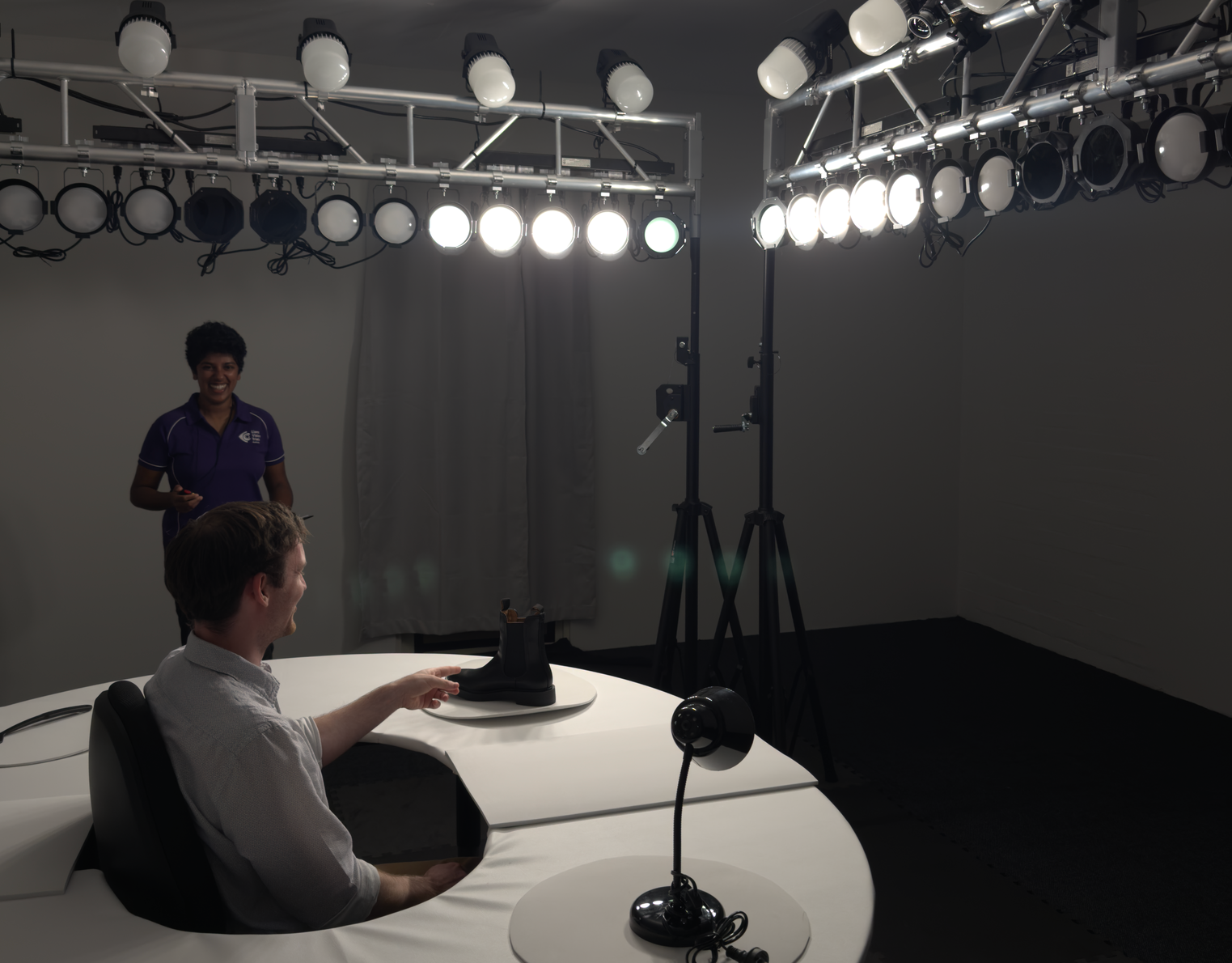
Dr Randolph Dobson, Miocevich Fellow and sub-investigator for the trial and Victoria Mendis, clinical trial coordinator, demonstrate the room light direction test and the object identification test, which evaluate functional vision for people with very low vision
Current progress and participant stories
To date, two participants have undergone treatment at the Lions Eye Institute, and approximately six participants in total are to be treated at the Lions Eye Institute in this mid-phase of the study. Overall, approximately 36 participants may take part in Kiora’s overall study across five sites in Australia (Adelaide, Brisbane, Melbourne, Perth and Sydney) with expansion to Auckland, New Zealand planned.
Looking ahead
As the trial continues to unfold, the Lions Eye Institute and Kiora are hopeful that the KIO-301 treatment will lead to a new era of vision restoration for individuals suffering from advanced retinitis pigmentosa. With no safety issues in Phase 1 and promising early signs of efficacy, the team looks forward to expanding the study and potentially offering life-changing treatments to those with the most severe visual impairments.
The team behind the study
The Abacus-2 Study in Western Australia is led by Associate Professor Fred Chen, Principal Investigator at the Lions Eye Institute. His extensive experience and dedication to advancing vision restoration research are at the heart of the study’s progress.
Supporting him in the clinical trial is a large multi-disciplinary team including Fellows, retinal specialists, study coordinators and orthoptists from the Lions Vision Trials team. Together, this team is overseeing the clinical protocol and ensuring the trial progresses smoothly, with patient safety as a primary concern.
Bob’s story
 The first patient to participate in the trial was Bob, who was diagnosed with retinitis pigmentosa at the age of 31. Now 70 years of age, he has been a patient of the Lions Eye Institute for almost 40 years. An avid Dockers supporter and football fan, Bob enjoys sport, music and playing guitar. A panel beater by trade, Bob was busy running a business, driving and taking care of his young family in his early thirties.
However, his world changed dramatically when he was diagnosed with retinitis pigmentosa. “It was like 20 semi-trailers hit me all at once,” Bob recalls. There was no cure or treatment at the time, and Bob was told that he would start losing his vision in his 40s. “I knew what was waiting for me” he says. His vision progressively worsened, until he reached a point where he could only distinguish between day and night. Before the trial, his vision had no colour and it was like looking through a fog. Bob’s story isn’t just about his own journey, it’s about the future he hopes to help create for others.
“My main wish is that young people don’t have to go through what I did. I’m lucky to have a loving family, but losing your vision takes so much away from you; the ability to work, to drive and do the things you love. I just hope that someone has the brains, resources and investment so that future generations of people with retinitis pigmentosa won’t have to go through what I did.”
While Bob won’t know whether he received the placebo or the KIO-301 injections until the trial concludes (and to preserve the integrity of the study, we are limited in what we can share), his experience participating in the study has been very positive.
Reflecting on his experience with the Lions Eye Institute, Bob shared, “I can’t speak highly enough of everyone there. They make everything worthwhile. If I feel a bit down, they keep me going. The team has been incredible.”

