
In this special feature, we sit down with three key members of our leadership team, Professor Chandra Balaratnasingam, Medical Director; Associate Professor Fred Chen, Director of Research; and Associate Professor Holly Chinnery, Deputy Director of Research to hear their perspectives on the evolving landscape of eye care and research at the Lions Eye Institute.

Professor Chandra Balaratnasingam, Medical Director
- How do you see the evolving role of clinical care in advancing our mission?
Clinical care is central to the Lions Eye Institute’s mission. Through patient care, we identify where the need is greatest and where outcomes can be improved.
I see our role evolving through continued investment in advanced surgical technologies and cutting-edge diagnostic platforms, allowing us to detect diseases earlier and manage them more precisely.
The challenge is meeting growing demand while preserving excellence and accessibility, and I’m confident in the Institute’s strategic direction to meet this need.
- How do you ensure collaboration between clinical teams and researchers?
The Institute’s core strength lies in the close collaboration between clinicians and researchers.
As Medical Director, I strive to foster an environment that encourages cross-disciplinary collaboration, shared priorities and investment in technologies.
This creates a culture where clinical challenges drive meaningful research, shortening the path from discovery to clinical application. It ensures that new knowledge directly improves patient care and provides personalised treatment options.

Associate Professor Fred Chen, Director of Research
- What’s your vision for the future of research at the Lions Eye Institute?
I see research at the Lions Eye Institute remaining high-quality, focused and impactful, to address the most common causes of blindness while not overlooking rare diseases.
We aim to build teams led by internationally recognised experts, working closely with global partners, and secure large-scale funding so our scientists can focus more on discovery and less on grant writing.
Equally important is strong collaboration between clinicians and laboratory researchers to tackle unmet clinical needs and accelerate meaningful breakthroughs.
Looking ahead, we see the Institute becoming a preferred clinical trial site across Australia and South-East Asia, expanding access to novel therapies.
- What is the biggest challenge facing vision science, and how is the Institute addressing it?
One of the biggest challenges is funding. Like many research organisations, we rely on competitive government grants, which can be limiting. To address this, our philanthropic, research, and finance teams are working together to secure more sustainable funding that supports the Institute as a whole.
Another challenge is supporting early and mid-career researchers. We’re formalising mentorship programs to help develop the next generation of scientists.
It’s also crucial that our research leads to real-world impact. Knowledge must translate into meaningful change for patients, starting with a deep understanding of unmet clinical needs.
We encourage strong partnerships between clinicians and lab researchers to ensure discoveries are driven by real patient experiences, and we support community involvement to keep our work focused on what matters most to patients and their families.
- How do you stay motivated and inspire your team?
What motivates me is seeing patients every day who are gradually losing their vision, often from conditions we still don’t fully understand or can’t yet treat. That’s a powerful reminder of why this work matters.
I try to inspire my team by focusing on the potential impact of our discoveries, which can change the lives of thousands of families. Even small advances in understanding a disease can bring hope and keep us driven through the challenges of research.
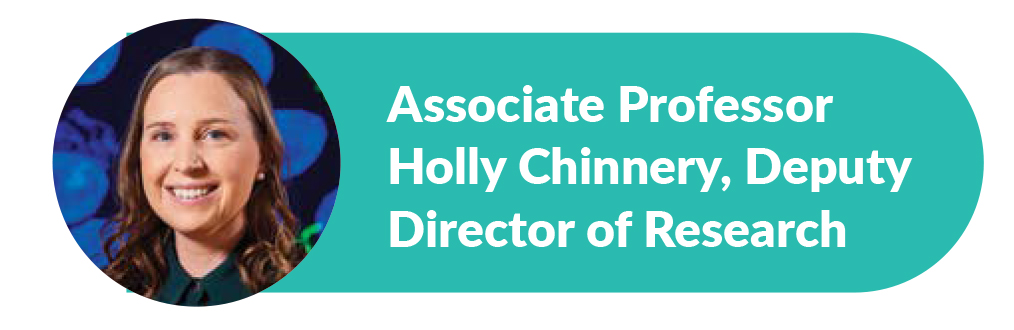
Associate Professor Holly Chinnery, Deputy Director of Research
What excites you most about the current direction of research at the Institute?
What excites me most is how what we could only dream about five years ago is now becoming a reality. New avenues of scientific pursuit in vision science and ophthalmology are opening up, particularly in areas like ocular surface immunology, gene therapy and advanced intravital imaging.
These innovations are evolving rapidly, and we are at the forefront of harnessing them to improve patient outcomes. The potential to revolutionise how we diagnose, treat, and prevent eye diseases is enormous, and it’s thrilling to be part of that transformation.
What do you believe is the next big breakthrough in eye research?
With our understanding of ophthalmology evolving so rapidly, it’s difficult to pinpoint exactly where the next big breakthrough will occur.
The ability to visualise individual cells in living human eyes is a huge opportunity, that really can’t be overstated. Enabling the investigation of how the immune system contributes to eye disease, or using imaging to closely monitor a patient’s response to treatment at the single-cell level, is a unique aspect of ophthalmology and optometry.
It also offers an opportunity for biologists from different disciplines to use the eye as a gateway to understanding the cellular mechanisms of the body, making this an exciting space to work as a research scientist.
Whether it’s in precision therapy, regenerative medicine or next generation imaging tools, we are doing everything necessary to ensure that when the next breakthrough comes, we’ll be ready to lead the way.
A unified vision for the future
At the Lions Eye Institute, our leaders are dedicated to advancing the frontiers of ophthalmology and vision science as well as other disciplines that impact eye health, such as immunology and neuroscience.
With a shared commitment to innovation, collaboration and excellence, our teams are ensuring that we continue to lead the way in both clinical care and research. Together, we are shaping the future of vision care, advancing life-changing treatments and making a profound impact on the lives of patients worldwide.

