
“International collaboration is essential to delivering meaningful advances for patients with retinal disease, and the Lions Eye Institute is proud to play a leading role in these global efforts.”
Associate Professor Fred Chen
Advancing the frontiers of medical research has always relied on more than individual expertise, it depends on connection, collaboration and shared vision. At the Lions Eye Institute, collaboration is not simply a feature of research, it is the foundation that enables discovery, accelerates innovation and ultimately improves patient outcomes.
Research without borders
Nowhere is this more evident than in the work of Associate Professor Fred Chen and his team, whose 2025 research portfolio demonstrates the extraordinary impact of national and international partnerships in tackling complex eye diseases.
Across 24 publications in 2025, the team’s work spans inherited retinal diseases, gene therapy, advanced imaging, artificial intelligence and clinical outcomes research. These studies, including investigations into Usher syndrome, retinitis pigmentosa, CTNNA1-associated retinal dystrophy and macular degeneration, reflect a research program that is both deeply specialised and broadly connected. From laboratory-based stem cell models to real-world clinical data, each project is strengthened by the expertise and infrastructure of collaborating institutions.
A global network for sight
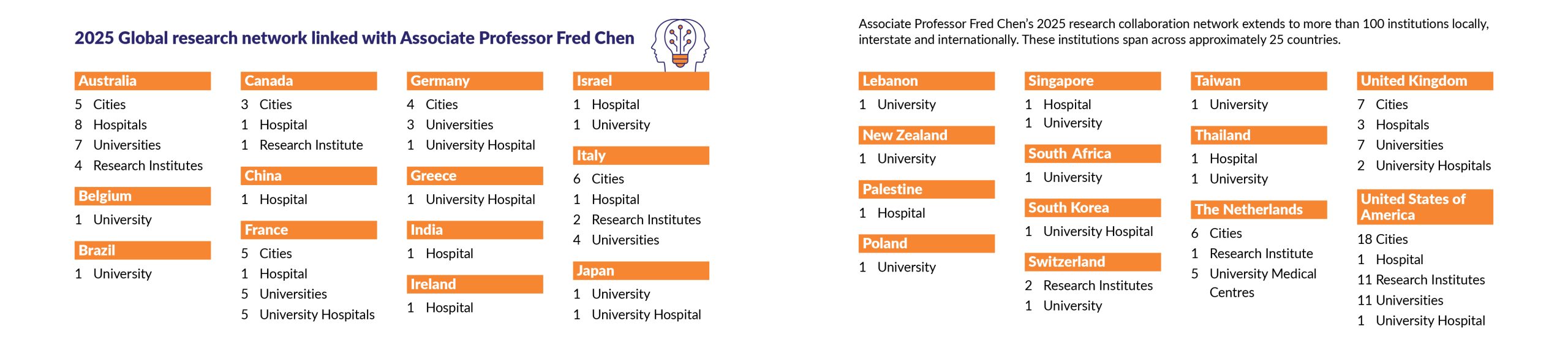
What sets this body of work apart is not only its scientific depth, but its global reach. The Lions Eye Institute and its partners collaborated with more than 100 institutions across approximately 25 countries in 2025. These collaborations span Australia, New Zealand, the United States, the United Kingdom, France, Germany, Italy, the Netherlands, Canada, China, Japan, South Korea, India, Israel, Brazil, South Africa and beyond, creating a truly international network dedicated to preserving sight.
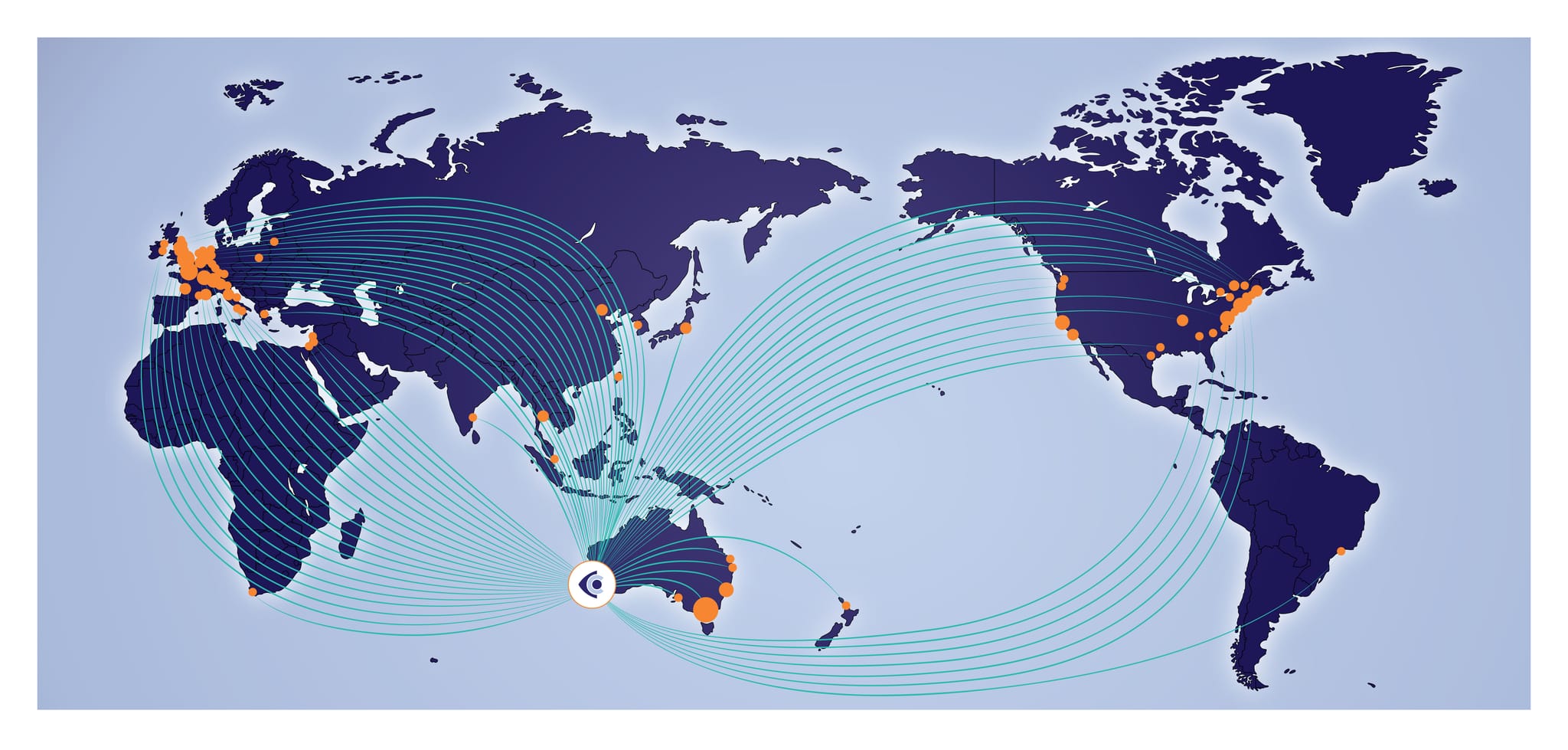
Associate Professor Fred Chen’s 2025 research collaboration network extends to more than 100 institutions locally, interstate and internationally. These institutions span across approximately 25 countries.
Strength at home
At a national level, strong partnerships within Australia provide a critical backbone for research translation. Collaborations with The University of Western Australia, Sir Charles Gairdner Hospital, Royal Perth Hospital and Perth Children’s Hospital ensure close integration between research and clinical care. Meanwhile, partnerships with institutions such as The University of Melbourne, Centre for Eye Research Australia, University of Sydney, Curtin University and the Walter and Eliza Hall Institute expand access to complementary expertise in genetics, immunology, epidemiology and public health.
By pooling data across centres, researchers can identify trends that would be invisible within a single institution, ultimately informing better care for patients across the country.
Driving discovery together
Internationally, collaboration enables the Lions Eye Institute to contribute to, and benefit from, global advances in ophthalmology. Large-scale studies draw on diverse patient populations and clinical practices. This diversity strengthens the evidence base, ensuring that findings are robust, generalisable and relevant to patients worldwide.
Similarly, cutting-edge research into gene therapies and inherited retinal diseases relies on access to specialised technologies and expertise distributed across the globe. Projects exploring induced pluripotent stem cell lines, genetic risk factors and novel disease mechanisms bring together clinicians, geneticists, bioinformaticians, and laboratory scientists from multiple disciplines. The result is a powerful multidisciplinary approach that accelerates the path from discovery to therapy.
Technology and teamwork
The integration of emerging technologies further highlights the importance of collaboration. The team’s review of artificial intelligence in inherited retinal diseases, along with studies using advanced imaging techniques such as optical coherence tomography, demonstrate how partnerships with data scientists, engineers, and international clinical centres are shaping the future of diagnosis and monitoring. These collaborations allow researchers to harness large datasets and sophisticated analytical tools that would be difficult to access in isolation.
Importantly, collaboration is not only about scale, it is about perspective. By working across health systems, cultures and scientific disciplines, researchers gain new ways of understanding disease. This is particularly valuable in rare and inherited conditions, where global collaboration is often essential to recruit sufficient patient numbers and uncover meaningful insights. Studies on conditions such as Usher syndrome, ROSAH syndrome and rare genetic mutations illustrate how shared knowledge can unlock answers for patients who might otherwise be left without options.
Looking ahead
For patients, the impact of this collaborative approach is profound. It means faster progress towards treatments, more accurate diagnoses, and access to clinical trials informed by the latest global evidence. It also ensures that Western Australian patients are connected to a worldwide network of expertise, bringing the benefits of international research directly into local care.
As the Lions Eye Institute continues to expand its research footprint, collaboration will remain central to its mission. In vision research, no single organisation can solve the most complex challenges alone. But together, through shared knowledge, resources and ambition, we can move closer to a future where preventable blindness is eliminated, and sight is preserved for all.
Formal and organic research collaboration
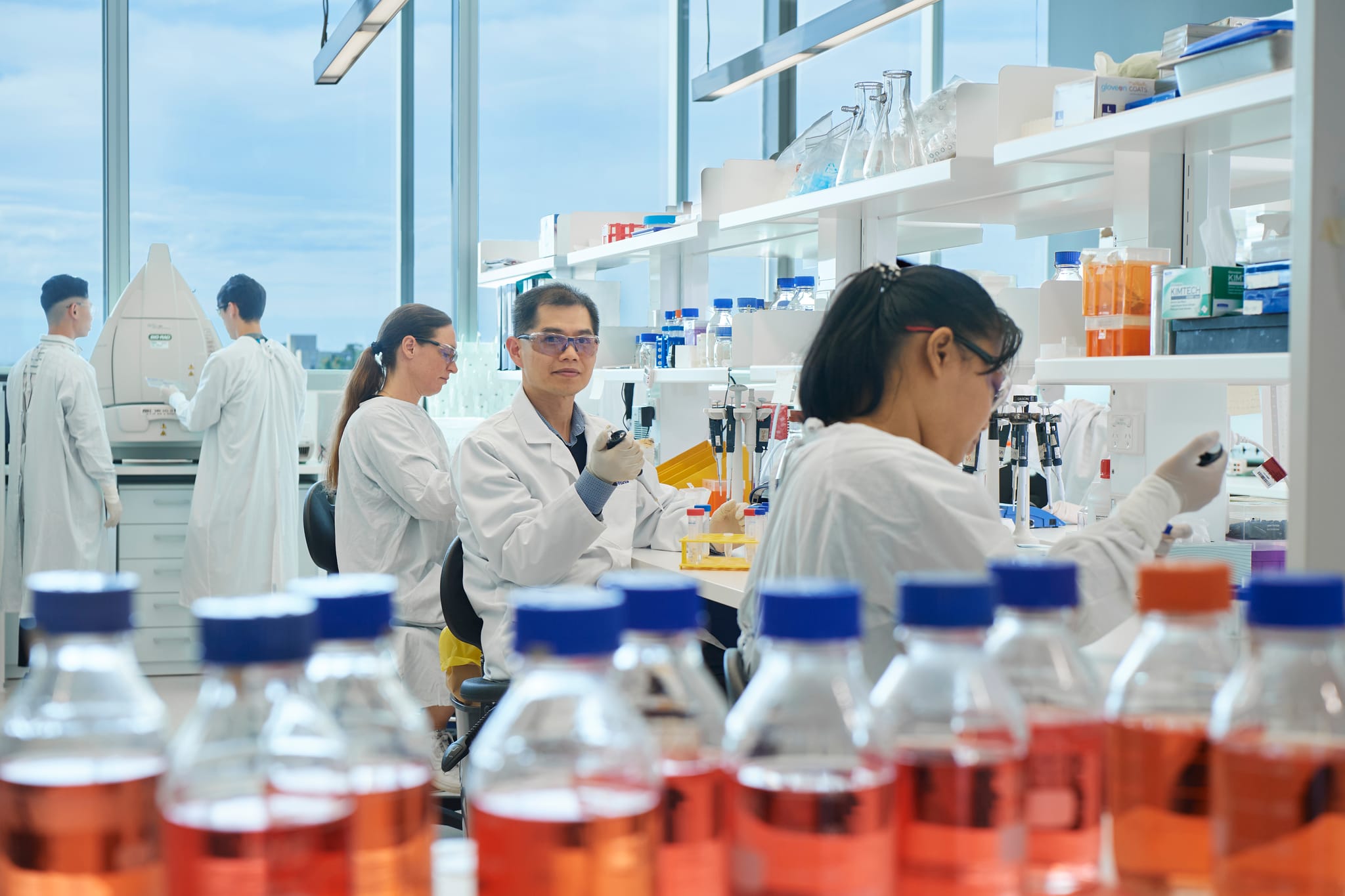
Associate Professor Fred Chen and researchers in the Lions Eye Institute’s research laboratories
Research networks can grow organically through inter-institutional collaboration, where researchers visit each other or meet up at conferences and decide to collaborate. It can also happen more formally, within defined international study groups. In this case, experts, like Associate Professor Fred Chen, are invited to join select groups and contribute to more structured research efforts.

