
Imagine looking at the world through an analogue television that can’t quite find its signal. A constant visual “static” overlaying everything you see, day and night. For people living with visual snow syndrome, this isn’t a metaphor. It’s an everyday reality.
Mel, a patient of the Lions Eye Institute, describes going “from someone who wore glasses for mild astigmatism to sometimes finding it almost impossible to see in the evenings.” Migraines have followed, sometimes so debilitating she needs to lie down. Light sensitivity means she can’t always go outside, with LED lighting proving particularly difficult. “Some days I can’t drive at all, and there’s no way of knowing which kind of day it’s going to be. Then the stress seems to make everything worse.”
Mel’s path to diagnosis took her through a string of specialists, each pointing her elsewhere, before she finally reached the Lions Eye Institute. The relief of diagnosis was real, but complicated. “You’re not going to go blind, but there’s also not much that can be done about the other symptoms,” says Mel, “People don’t understand,” she adds. “Education would be a really good thing, so that people take it seriously.”
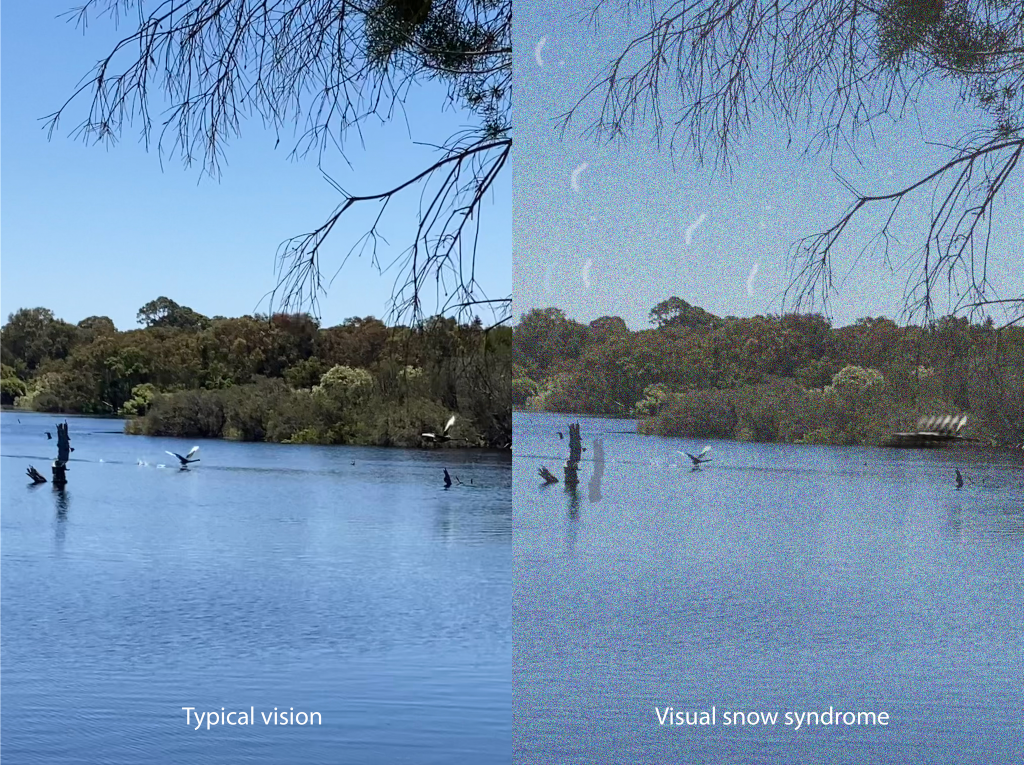
An illustration of how people with visual snow syndrome experience vision. Typical vision is depicted on the left, while the right illustrates some of the key visual symptoms of visual snow syndrome.
Visual snow syndrome is a neurological condition characterised by persistent visual “snow,” along with additional symptoms including trailing images, sensitivity to light, and difficulty seeing at night. It is thought to affect approximately 2 per cent of the population¹ – yet it only received formal International Classification of Diseases 11th Revision (ICD-11) classification in early 2025, after years of being misattributed to migraine or dismissed altogether. “Awareness is improving, but there are still plenty of people who have gone years without a diagnosis,” says Dr Cassandra Brooks, research fellow at the Institute. “There are a lot of unmet needs.”
What the research is showing and what we’re doing about it
Dr Brooks and collaborators Professor Allison McKendrick, The University of Western Australia Chair in Optometry Research at the Institute, and Dr Bao Nguyen at the University of Melbourne recently published a review in the Annual Review of Vision Science² examining how visual perception research is advancing understanding of visual snow syndrome, and how behavioural vision tests could one day become objective tools for tracking severity and measuring treatment response in clinical trials. The team is also currently surveying Australian optometrists to understand what the profession knows about visual snow syndrome and what education they need.
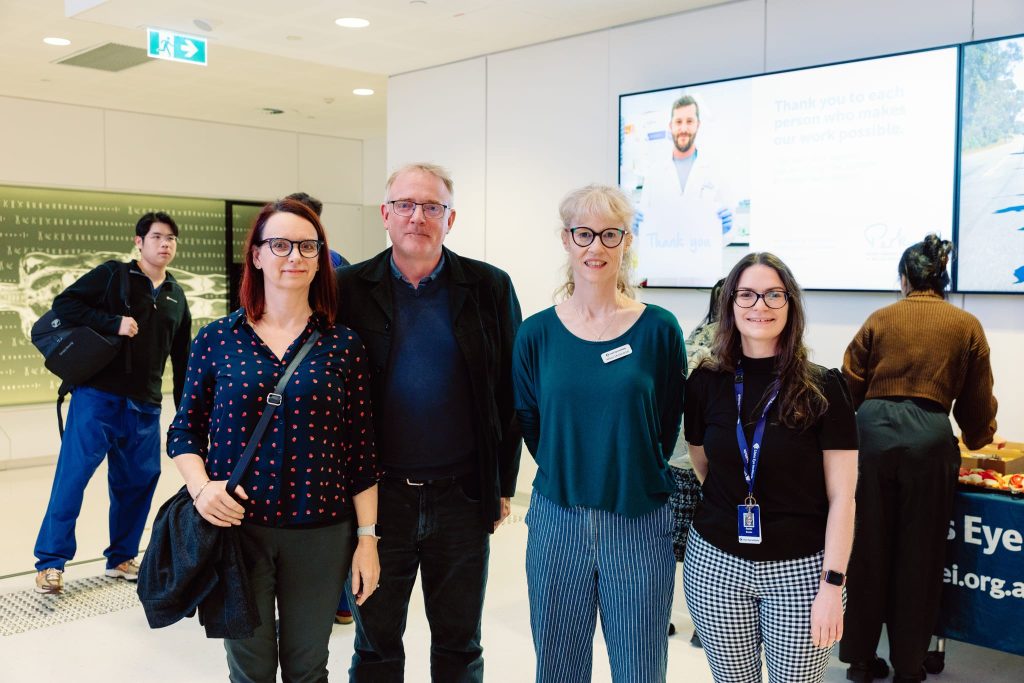
Magda Toth (left) and Andrew Porter (middle-left), who are supporting research into visual snow syndrome, with Professor Allison McKendrick (middle-right) and Dr Cassandra Brooks (right)
Stories like Mel’s are why this research matters. This Medical Research Giving Day, your support will help the Lions Eye Institute continue its crucial sight-saving work, driving the discoveries that bring real hope to people living with vision loss.
¹ Kondziella D, Olsen MH, Dreier JP. 2020. Prevalence of visual snow syndrome in the UK. Eur. J. Neurol. 27:764–72
² Brooks CJ, Nguyen BN, McKendrick AM. 2026. Visual Perception in Visual Snow Syndrome. Annual Review of Vision Science 12. https://doi.org/10.1146/annurevvision-103025-035537

