
Professor Bill Morgan AO honoured for a lifetime of curiosity
When Professor Bill Morgan was appointed an Officer of the Order of Australia (AO) in the 2026 King’s Birthday Honours, it recognised far more than an outstanding career in ophthalmology. It celebrated a lifetime of asking difficult questions, challenging conventional thinking and pursuing better outcomes for people facing blindness.
For supporters of the Lions Eye Institute, the honour is especially significant. Professor Morgan has been part of the Institute for more than three decades as clinician, researcher, inventor, teacher and former Managing Director. Throughout that time, his work has reflected the values that define the Institute: world-class research, exceptional patient care and a determination to ensure breakthroughs reach the people who need them most.
What has always set Professor Morgan apart is his insatiable curiosity. His research into the complex relationship between pressure, blood flow and the optic nerve has reshaped the understanding of glaucoma and continues to influence patient care around the world.
Solving problems that matter
Glaucoma, often called the ‘silent thief of sight’, gradually damages the optic nerve and remains a leading cause of irreversible blindness worldwide.
Professor Morgan’s work spans fundamental discoveries about glaucoma and entirely new surgical treatments. Among his significant achievements was co-inventing the XEN® Gel Stent, a minimally invasive glaucoma implant now used internationally to help preserve vision for hundreds of thousands of patients.
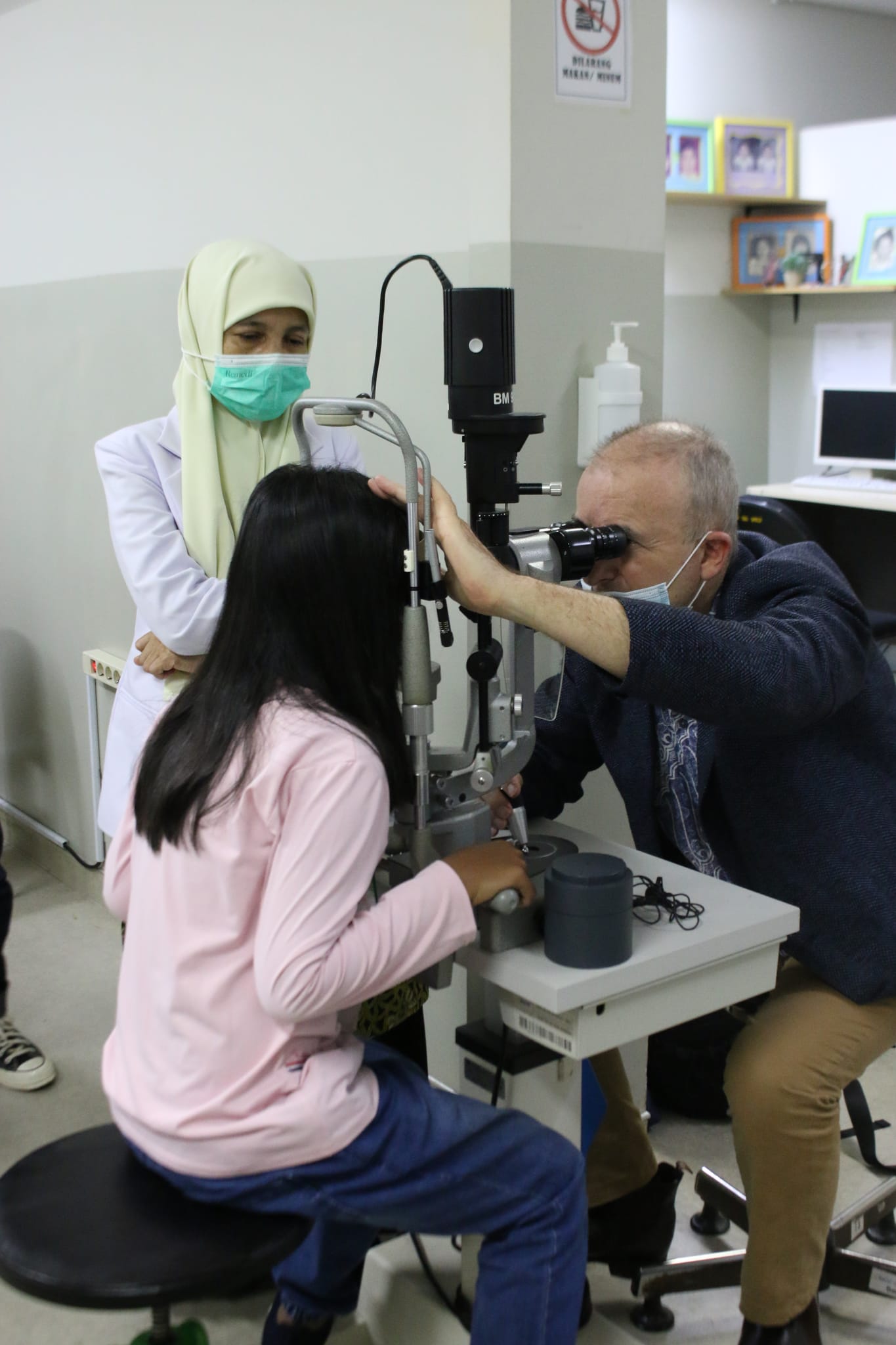
Dr Virna Oktariana (left) and Professor Bill Morgan AO (right) examining a patient’s eyes at the launch of the paediatric version of the Virna Glaucoma Drainage Device in Indonesia
More recently, he collaborated with Indonesian ophthalmologist Dr Virna Oktariana to develop the Virna Glaucoma Drainage Device, an affordable implant designed to make sight-saving glaucoma surgery more accessible in lower-income countries. In 2024, they also launched a paediatric version.
It reflects Professor Morgan’s philosophy: innovation should not simply be clever, it should improve lives.
That philosophy continues to drive his research. He is leading work to develop a handheld device capable of measuring intracranial pressure without invasive procedures. If successful, it could transform diagnosis and monitoring of conditions affecting the brain and optic nerve, with applications across ophthalmology, neurology and space medicine. Professor Morgan plans to test the device in zero gravity for the first time in 2027.
Looking beyond Australia
Professor Morgan’s global contribution extends beyond research and innovation. For decades, he has worked extensively in Indonesia, teaching surgeons, mentoring researchers and strengthening local eye care through enduring partnerships with hospitals and universities. His focus has always been collaboration – working alongside local clinicians to develop solutions that are affordable, sustainable and appropriate for the communities they serve.
Since 2000, Professor Morgan has visited Indonesia with the John Fawcett Foundation once or twice a year, teaching, operating and conducting research. This work has grown into a formal reciprocal observation program, with young Indonesian doctors from Bali and Jakarta visiting the Lions Eye Institute for short observerships. Two Australian trainee eye surgeons now also visit Indonesia annually.
Professor Morgan is dedicated to strengthening Indonesia–Australia relations, which he believes will be mutually advantageous. The research collaboration is now extending into large-scale population screening for glaucoma, diabetic retinopathy and other eye diseases, with Lions Eye Institute academic and scientific staff working closely with Indonesian ophthalmologists.
Curiosity without boundaries
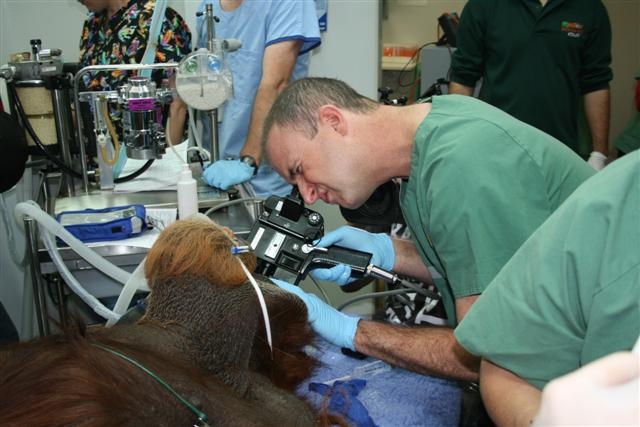
Professor Bill Morgan AO examining Hsing Hsing the orangutan’s eyes in 2008. Hsing Hsing lived at Perth Zoo and was found to have glaucoma in his right eye, causing 98 per cent vision loss in that eye
Professor Morgan’s curiosity has taken him into some unexpected places. In 2008, one of his patients was Hsing Hsing, the much-loved diabetic orangutan at Perth Zoo. Performing delicate eye surgery on an orangutan, in collaboration with a veterinary ophthalmologist from Murdoch, was certainly outside the typical ophthalmologist’s workload – but for Bill it was another opportunity to apply his expertise where it could make a difference.
His interests have also extended into space medicine, investigating how changes in pressure affect astronauts’ vision during long-duration spaceflight. The same scientific questions that help explain glaucoma on Earth may help protect eyesight in space – a reminder that great research often connects seemingly unrelated worlds.
A well-deserved honour
For everyone at the Lions Eye Institute, Professor Bill Morgan’s appointment as an Officer of the Order of Australia is a proud moment. It recognises a clinician who has cared for countless patients, an inventor whose ideas have preserved vision around the world, a researcher who continues to push the boundaries of science, and a mentor who has inspired generations of clinicians and scientists.
Above all, it recognises someone who has never lost sight of why the work matters.
“Every discovery, every new device, every collaboration and every patient represents another step towards a future where fewer people lose their vision,” said Professor Morgan AO.
Congratulations, Professor Bill Morgan AO, on this richly deserved recognition.
Did you know?
Professor Bill Morgan AO:
- Performed eye surgery on Hsing Hsing, an orangutan who had glaucoma, at Perth Zoo.
- Has examined elephants with eye problems in Bali.
- Co-invented the XEN® Gel Stent and Virna Glaucoma Drainage Device, helping prevent vision loss in glaucoma patients globally and in Indonesia.
- Is planning to go to zero gravity to test an intracranial pressure measurement device he is developing.

